U Turns, New Turns, and Thingamajigs
Observing drivers and driving ethos has been inherent, maybe due to living in many countries and cities from childhood. This year, we visited some cities within the United States in quick succession giving me comparable data points within a very short span of time. Atlanta, to me, appears to have the worst drivers. In the best selling The Book of Joy, Douglas Abrams specifically asked Desmond Tutu how he would react to bad drivers – Tutu, in true fashion expected of a spiritual seer who had seen incredible tumult, said that he would empathise – think that ‘perhaps the driver was on his way to the hospital because his wife was giving birth, or a relative was sick’. Well, even Tutu might have thrown up his head in incredulousness, at the very least, in Atlanta. Drivers do everything from turn left in one go from the right most lane in a 6-lane highway, sans indicators, to an abrupt U Turn in the middle of traffic to parallel park (no indicators, of course) to regularly driving in the wrong direction on one-way roads to paying no heed to pedestrians who are walking on a walk sign. Indian-origin friends who have been in the US for many years often comment about chaotic driving in India – yes, it is definitely chaotic but speeds are so low that one still has enough reaction time. In Atlanta, the safest driver can be caught unawares. It surprised me that neither Seattle nor New York City nor San Francisco nor their respective suburbs could hold water to Atlanta…. Add to this the fact that the state of Georgia does not need vehicle inspections – this means one can see cars without an entire door or window, and much else too. Compare this to, say, Pennsylvania, where an annual stringent inspection is mandatory and the slightest thing awry like a broken tail light or an indicator not working would need to be fixed before inspection is passed.
We do not drive much at all – thanks to good location with immediate access to public transport, a proclivity to walk a lot and choosing to restrict activities to within a narrow radius. While not given to abusing other drivers whilst driving, if immediate family is at hand, we draw their attention to whatever draws ours. We have had many a laugh at some outright comical things we have seen on the roads…. A bit of Tutu did get into us, it appears.
For some time now, I have engaged in philosophical reading, listening and exchange of ideas, specifically The Bhagavad Gita and Advaita. It has been enlightening to know a little of what I did not and also to realise that this journey is literally never ending – one realises that not only is one step forward in equanimity followed by multiple of the opposite, just registering that step forward as an achievement is itself a journey in the ego. Looking at this writing here, I cannot help realise how many ‘I’s are mentioned, including in this sentence – that very mention of the ‘I’ indicates that one is nowhere near where one needs to be.
The Bhagavad Gita says that we are all innately the Atman – the pure Self in total bliss at all times. The reason we do not feel that way is because we identify ourselves with the mind and the body which results in doership – the ‘I’ or the ego. Shed doership and you are free here and now says Krishna to Arjuna. Anything wise and good is hard to follow but something so profound is, at least, for me, impossible in this birth. But the good individuals I discuss such topics with are kind enough to not only tell me that the process itself is progress but that they too struggle with very similar issues.
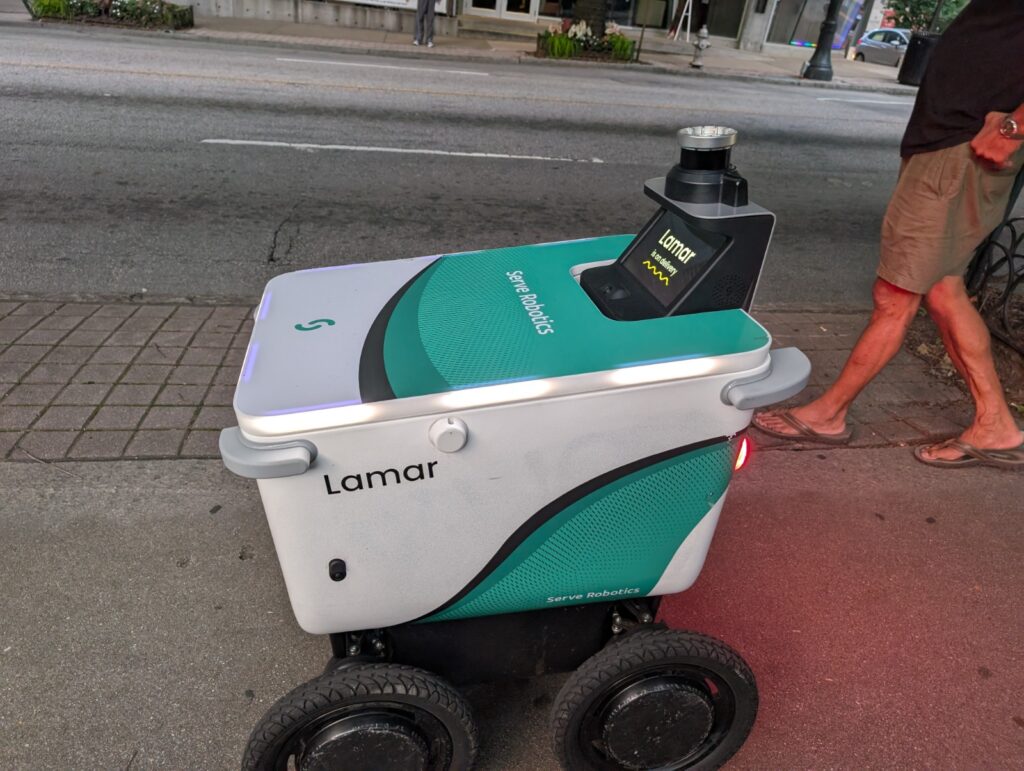
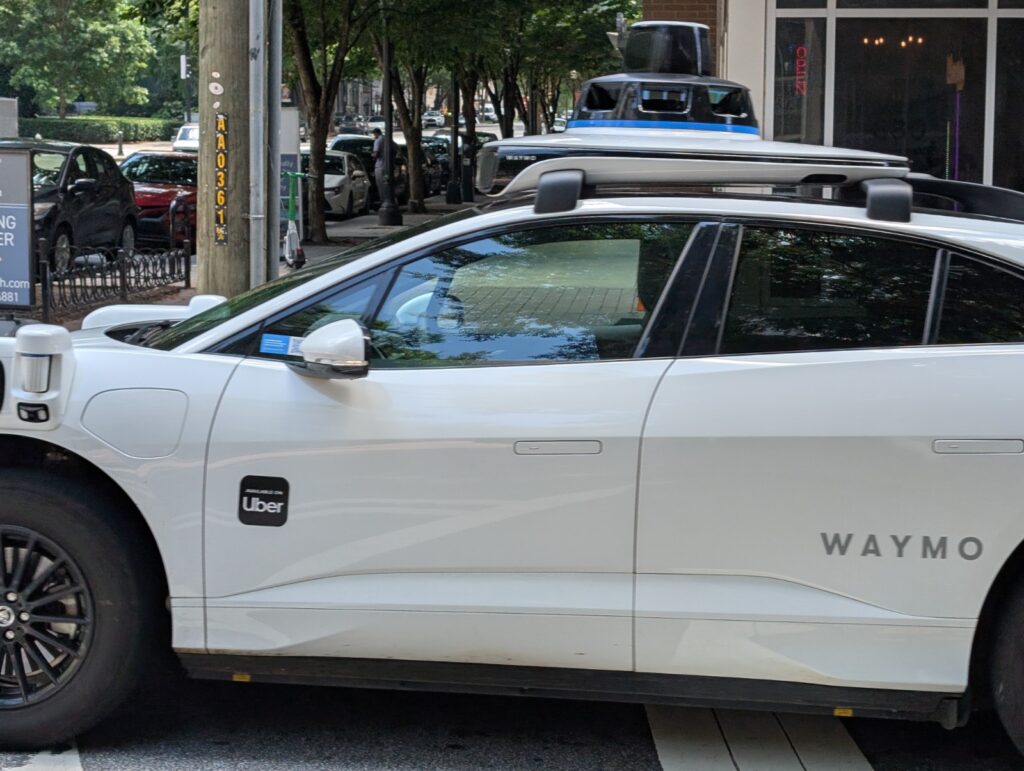
Now you are asking why in the world we switched from traffic to Bhagavad Gita. Good question, and as the excellent Pankaj Tripathi says in the lovely Hulu series Criminal Justice, I am getting there. The other day, as I made to cross the road at a busy intersection, I noticed an Uber delivery robot slowly cross the same intersection. When the walk sign came on, it stepped out gingerly (one could imagine it looking at both sides carefully) before having to stop for vehicles turning left very fast from the perpendicular – without waiting for it or human pedestrians to finish crossing (Atlanta, remember?). I waited to see what this no-more-than-2-feet-tall, unmanned, very cute, thingamajig would do. It waited midway allowing car after car to go forward. Then came a WayMo driverless car, also attempting to take the same left from the perpendicular, like all the offending human operated cars, but slower – just as we would want our own children to drive. I held my breath. WayMo did part of the turn and then completely stopped, allowing its much smaller compatriot, albeit of a different genus, cross safely and completely before it executed its own turn.
Both unmanned things behaved exactly as advocated by The Gita. Do your duty as you are supposed to – with care, attention and diligence, but sans ego or expectation of any kind of result. Be accepting of any outcome, good and bad with equal equanimity – utterly reactionless. The WayMo did not insist on going forward to assert its much larger size and significantly greater capabilities. The Uber thingamajig did not give up making its delivery or return to square one. They both continued accomplishing what they were supposed to, reacting in real time to several unpredictable moving parts, but without any other reaction. Lest you think this was just one occasion, I saw another thingamajig struggling at the same intersection on another day. There were only human drivers and no one was giving it an inch. If there is a signal, thingamajig will go only when the walk sign is on. It observed for a full minute then rotated 90 degrees and drove itself to the next intersection – constructive action, without protesting or shutting down or wasting time, while still taking it in the correct direction. At the next signal, it crossed the street uneventfully. How Atlanta would be if many more cars were driverless, I thought.
Well, obviously, a gadget does not have a mind or a body it is egoistically cognisant of. Yet it was very much a lightbulb moment – another reminder to live in the present, be as non-reactionary as possible, not get too excited about what we deem as good and not to be despondent when things do not go the way we wanted them to. Because that is all they are – our thoughts and expectations which, as per the Gita, are not real. We deem things as good or bad, mostly through socialisation and peer pressure, but thinking, not just of such aspects, but the very act of thinking itself, destroys the unblemished happiness that can be ours right now. Before anyone gets up in arms here, I repeat what I already said – this, erasing thoughts and being subsumed in the self, is the goal. I am not even close and will not reach it in this birth. But it is progress to note the occasions when we succeed at mind control and especially when we fail, registering why and how to prevent that failure on the next occasion.